
Last updated September 20, 2026
Free on-site gate assessment - hinges, posts, and your LiftMaster or Nice gate operator checked before anything is quoted
The assessment is free and the quote is the invoice.


 Before
 After
After Before
 After
After Before
 After
AfterGate Repair Maintenance Checklist for Sherman Oaks Homeowners
Here’s the thing about gate maintenance checklists: most of them are useless. They tell you to “check that the gate moves smoothly” or “listen for unusual noises,” which is the maintenance equivalent of telling someone to “check that their car still drives.” You already know the gate opens and closes. What you don’t know is whether the chain has 3/8 inch of slack or 1.5 inches of slack, whether that translates to a $45 adjustment or a $900 motor replacement, and whether the wobble in the hinge is normal wear or a post that’s slowly pulling away from its footing. A useful checklist gives you numbers. A properly tensioned slide gate chain should deflect no more than half an inch under firm thumb pressure at the midpoint. A swing gate hinge should have no more than 2 degrees of vertical play when you lift the gate leaf. In Sherman Oaks, where our hillside lots put real weight on gate hardware and our brush-clearance cycles blow fine particulate into every moving part, those thresholds matter more than they would in a flat, clean-air suburb. This guide is built the way we work at Vance Gate Repair: every check has a pass/fail line, a what-to-do-next, and a cost frame so you’re making a decision, not a guess.
Quick Answer
A practical gate maintenance checklist for Sherman Oaks homeowners has about ten measurable items, but the three that prevent the most expensive failures are limit switch drift, battery voltage under load, and gate post movement. Most checks take under ten minutes total, need no tools beyond a tape measure and a phone camera, and can be done every 90 days. For more guides & resources on gate care, see our blog. Anything involving live 24V or 120V wiring, spring tension, or post re-setting is a technician’s job, and we recommend documenting every inspection with photos so the next repair call starts with evidence, not memory.
Table of Contents
- Chain and Belt Tension: The Half-Inch Test
- Hinge Play and Post Movement: The 2-Degree Rule
- Photo-Eye Alignment and the Sherman Oaks Dust Problem
- Limit Switch Drift: What It Looks Like From Outside
- Battery Voltage Under Load: The Number That Lies Until It Doesn’t
- What to Document and How: Your Own Photo Record
- Seasonal Notes for Sherman Oaks: Brush Clearance, Heat, and Hills
 Before
 After
AfterChain and Belt Tension: The Half-Inch Test
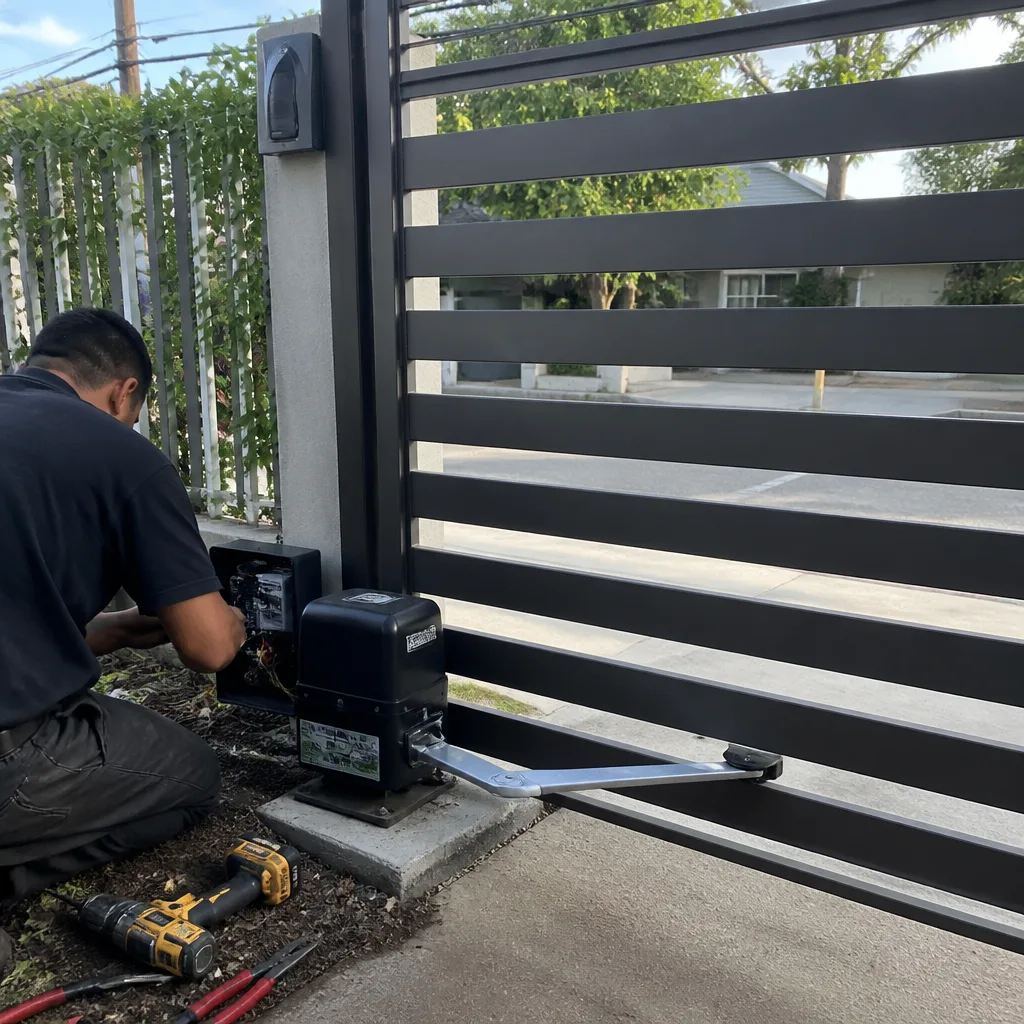
On a slide gate, the chain or belt is what connects the motor’s output sprocket to the gate itself. If it’s too loose, the gate will rattle on startup, hesitate mid-travel, and eventually jump teeth or throw the chain entirely. If it’s too tight, you’re loading the motor shaft and the sprocket bearings in a way that shortens both. The check is simple: with the gate in the closed position, press your thumb firmly against the chain at the midpoint between the motor sprocket and the gate’s attachment bracket. The chain should deflect no more than half an inch. That’s not a “feels about right” measurement. Half an inch, measured. If you’re at 3/4 to 1 inch, you have a minor adjustment window, but schedule it. If you’re past 1 inch, you’re at real risk of the chain jumping the sprocket during operation, which can scar the sprocket teeth and leave the gate stopped halfway with a live motor trying to continue.
For belt-drive slide gates, the same general principle applies on deflection, but belts age differently than chains. A belt doesn’t rust, but Sherman Oaks heat will bake the neoprene until it cracks at the tooth roots. Run your fingers along the underside of the belt (with the motor unplugged). If you feel hairline cracks every few teeth, the belt is toward the end of its service life. It usually fails catastrophically rather than gradually, so the cost of ignoring a cracked belt is a gate that won’t open one morning and a belt replacement that now requires re-tensioning and possibly sprocket inspection. Belt replacement on a typical residential slide gate in Sherman Oaks runs roughly $220 to $400 depending on the length and the motor model, assuming the sprockets are still serviceable.
Who should adjust chain tension?
If the chain is slightly loose and you have the mechanical inclination, the tension adjustment itself is accessible. But know this: the motor’s internal limit settings are calibrated to the gate’s travel distance, and changing chain tension shifts effective travel by a small amount. After any chain adjustment, the limit switches need to be checked. If you’re not prepared to do that, call us. A full chain tensioning and limit verification visit is the kind of job where Gate Repair in Sherman Oaks is a same-day service with a written price before we touch anything.
Hinge Play and Post Movement: The 2-Degree Rule
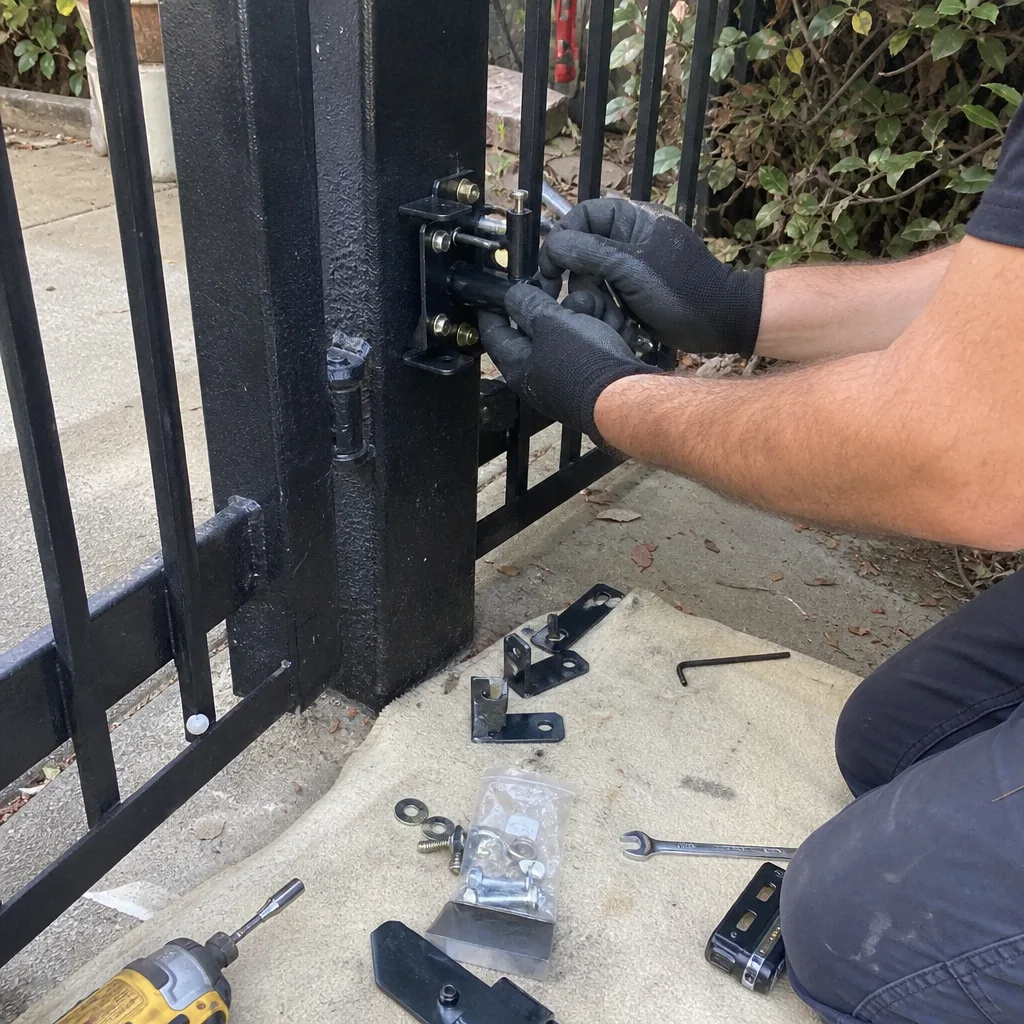
Hinges wear. That’s normal. What matters is whether the wear has reached a point where the gate leaf is now levering against the post, because that’s when you get a compounding failure: hinge play causes the gate to droop at the free end, the droop makes the gate bind at the latch or the closer, and the binding makes the operator work harder every cycle. The measurement we use is vertical play. Lift the free end of the gate leaf straight up. You’re looking for 2 degrees or less of angular movement at the hinge. Without an angle finder, here’s the practical version: if the free end of a 7-foot gate leaf moves more than about 2.5 inches vertically when you lift it, the hinge wear is past the monitoring point and into the repair point. Less than that, keep an eye on it and recheck in 90 days.
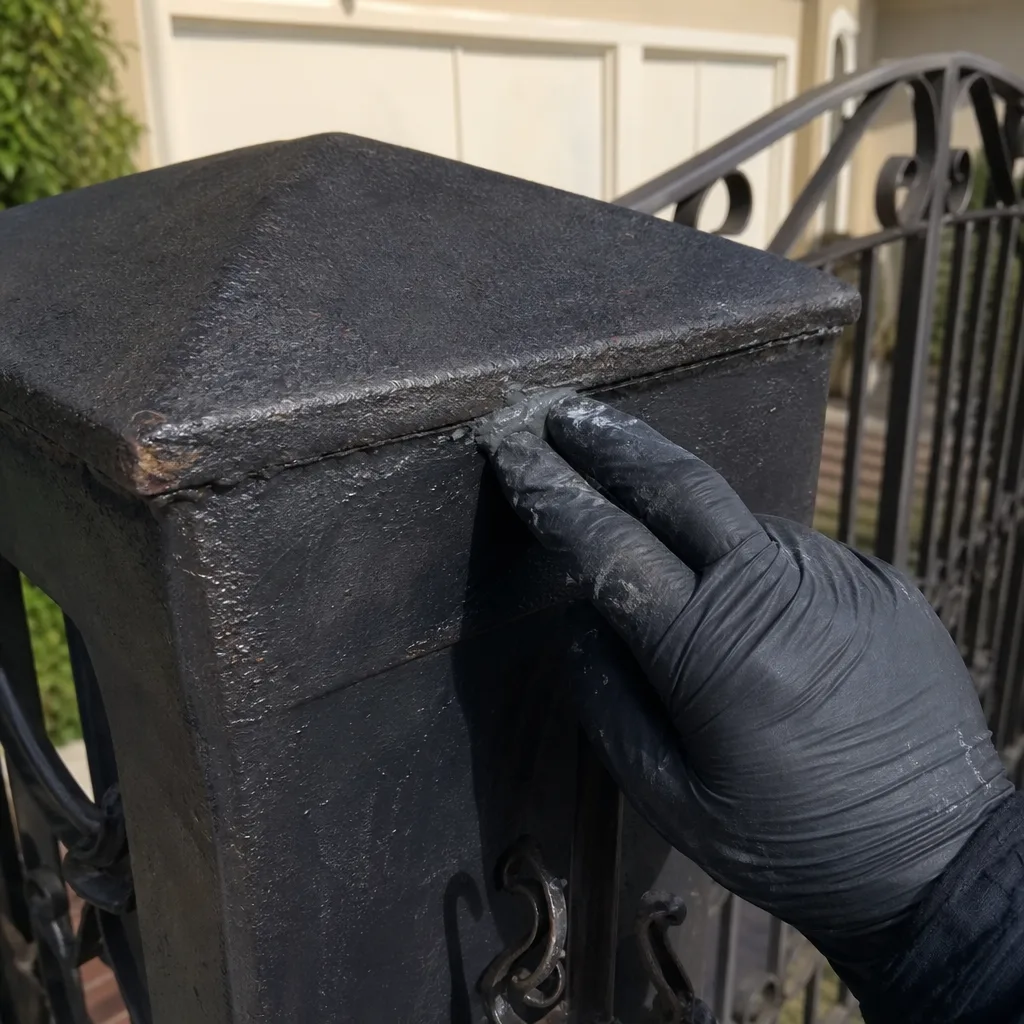
Post movement is the bigger problem, and it’s the one Sherman Oaks homeowners miss most often because it’s slow. A post that’s shifted a quarter inch in a month is a post that’s on its way to creating a gate that won’t line up with its latch or, worse, a post that’s carrying enough gate weight to crack its footing. Here’s how to check it. Stand back from the gate and sight down the line of the post against the wall, fence line, or adjacent hardscape. You’re looking for vertical plumb. A post that was installed plumb and is now leaning 1 degree or more from vertical is moving. The second check: look at the gap between the gate and the post at the hinge side. If that gap has changed from when the gate was installed, the post has settled or shifted. Mark the current gap with a pencil line on the post or take a photo. Recheck in 30 days. If the gap is still growing, stop using the gate and call us. Post re-setting in Sherman Oaks hillside soil typically runs $350 to $750 per post depending on the footing size and whether the existing concrete has to be cut out.
We’ve replaced gates in Sherman Oaks where the homeowner had been living with a gradually binding gate for two years. By the time we got the call, the post had moved 3 inches, the gate leaf had twisted to compensate, and the repair needed was a full post re-set, two new hinge weldments, and a gate re-hang instead of a bushing replacement. The post movement check above would have caught it in the first 90 days.
Photo-Eye Alignment and the Sherman Oaks Dust Problem
The photo-eye is the infrared beam that runs across the gate opening, usually at wheel height or ankle height. If anything interrupts the beam while the gate is closing, the gate should stop and reverse. It’s a safety device, not a convenience feature, and it saves fingers, paws, and bicycle wheels. But photo-eyes need to be aligned within a tight window, and that’s exactly what Sherman Oaks particulate attacks first.
Here’s the local context that matters. Sherman Oaks sits against the Santa Monica Mountain foothills, and our fire-prevention brush clearance cycles create a lot of fine dust and ash every summer and fall. That particulate settles on the photo-eye lens and inside the gate track. The photo-eye alignment tolerance on most residential operators, including Ghost Controls and Mighty Mule units we service regularly, is roughly ±2 degrees horizontally. Beyond that, the receiver doesn’t get a clean beam, and the gate behaves erratically: it might refuse to close, might stop and reverse for no reason you can see, or might sit there beeping at you. The fix is often as simple as wiping the lens with a dry cloth and nudging the receiver back toward the transmitter. We use a small bubble level on the face of each eye housing to confirm alignment. If you don’t have one, use the visual indicator: most photo-eyes have an LED that shows green when aligned and red when not.
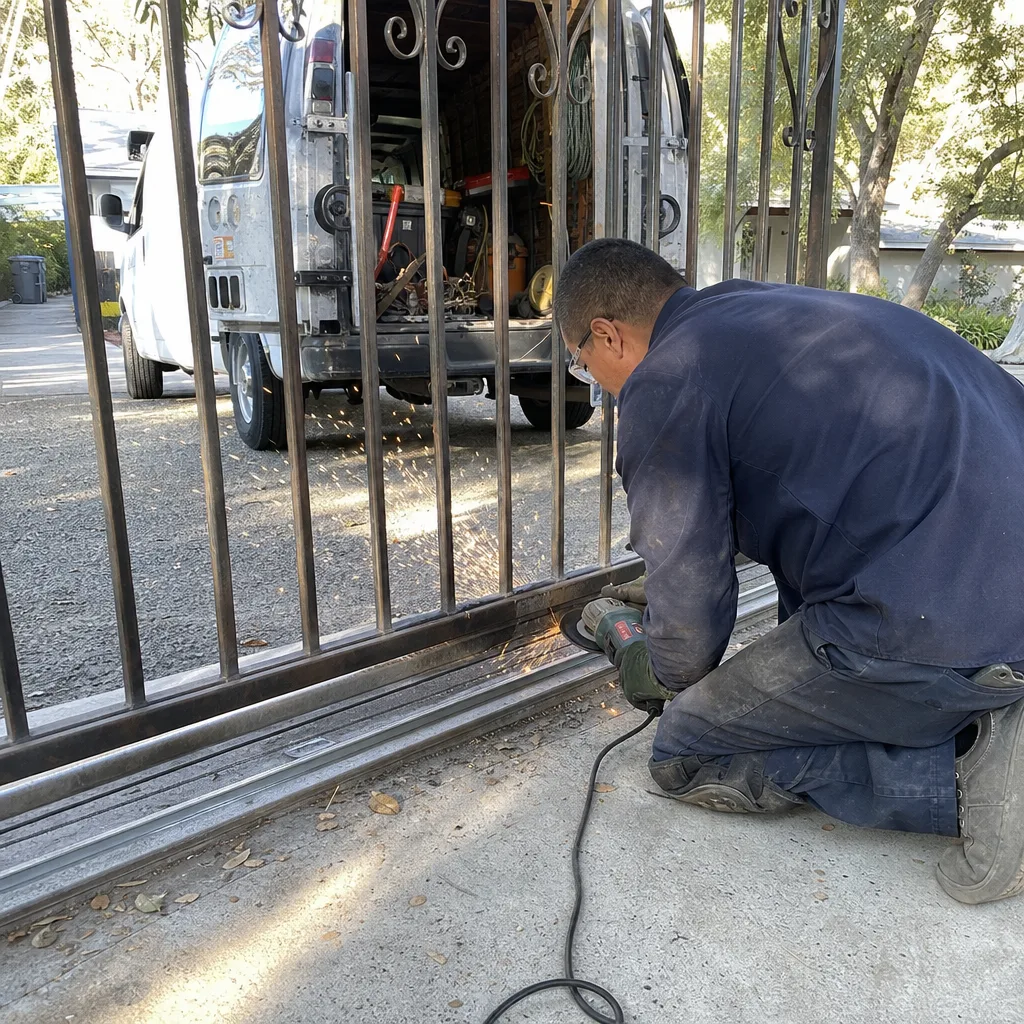
Here’s the deeper Sherman Oaks problem, though. The same particulate that fogs the lens settles into the drive gears and the track. On a slide gate, the track wheels are rolling through that dust every cycle, and it grinds into the wheel bearings until the wheels develop flat spots. A quick maintenance item: wipe the track rails clean with a dry rag every 90 days, and clear the debris out of the track channel. Don’t use grease on a slide gate track. Grease captures dust and makes a lapping compound. If your track wheels are noisy, they’re worn, and the repair is wheel replacement, not lubrication. Track wheel replacement on a standard residential slide gate usually lands between $180 and $320 in our Sherman Oaks service area.
Limit Switch Drift: What It Looks Like From Outside
The limit switch is what tells the operator where “open” is and where “closed” is. It’s a mechanical or magnetic marker inside the operator head, and the operator’s brain uses it to know when to cut motor power. When a limit switch drifts, the gate still opens and closes, but it stops in the wrong place. It might stop 4 inches short of the close post, leaving a gap your dog discovers. It might stop 6 inches past the open position, slamming the physical stop each time and slowly hammering the rack or the hinge welds. It might stop at a slightly different spot every cycle, which is the most confusing variant because there’s no single “wrong spot” to point at.
Here’s what you can observe from outside without opening the operator head. Run the gate through a full close and open cycle. At close, measure the gap between the gate’s leading edge and the fixed stop or latch post. At open, measure the gap between the trailing edge and the open stop. Write both numbers down. Repeat the cycle three times. If the numbers change by more than half an inch between cycles, the limit switch is drifting. If the numbers are consistent but the close gap is more than an inch, the close limit was set wrong at some point. Both need a technician’s adjustment.
Limit switch drift is one of the three items homeowners skip that causes the most expensive failures, because the gate keeps “working” right up until it doesn’t. The motor burns extra time against a stop it thinks isn’t there, or the gate rests against the close post under motor tension, which loads every hinge, wheel, and the rack gear overnight, every night. We’ve pulled operator covers off in Sherman Oaks and found the limit setting 12 degrees past the physical stop, meaning the motor had been pushing against solid steel at the end of every cycle for months. The repair at that point isn’t a $75 adjustment; it’s a $450 to $900 motor or gearbox replacement. The check above takes five minutes and costs nothing. If your numbers are moving, call us before the breakdown. Gate Motor & Opener service in Sherman Oaks is a core part of what we do, and we give you the price in writing before the work starts.
Battery Voltage Under Load: The Number That Lies Until It Doesn’t
If your gate operator has a backup battery, we’ll say this clearly: a battery that reads 12.6 volts on a multimeter can still be dead. The resting voltage tells you almost nothing. A battery only fails when it’s asked to do work, which in technical terms is voltage under load. You can watch this happen from outside. Run the gate through a full open cycle and time it. A healthy battery on a typical residential swing gate operator should open the gate in roughly 8 to 12 seconds. A dying battery will run the same gate in 14 to 18 seconds, and you’ll hear the motor pitch drop toward the end of travel. That’s the battery sagging under load.
If you have a multimeter, the better check is to measure voltage at the battery terminals while the gate is opening. A healthy 12V battery should hold above 11.8 volts under load. If it drops below 11 volts during operation, the battery is failing even if it reads 12.6V when the gate is idle. Replace it before the next Santa Ana wind event, because that’s exactly when Sherman Oaks loses grid power and the battery becomes the difference between a gate that opens and a gate you’re climbing over. Backup battery replacement for most residential operators runs $85 to $160 including the battery and the service call, and it’s a ten-minute job.
One more Sherman Oaks-specific note. Our summer heat waves shorten battery life faster than the manufacturer’s stated 3-5 year lifespan. If your operator is in an unshaded metal enclosure facing west, you’re baking the battery every afternoon from June through October. If your battery is more than three years old and it’s been through two Sherman Oaks summers, replace it proactively. The cost is trivial compared to being locked out of your own driveway.
What to Document and How: Your Own Photo Record
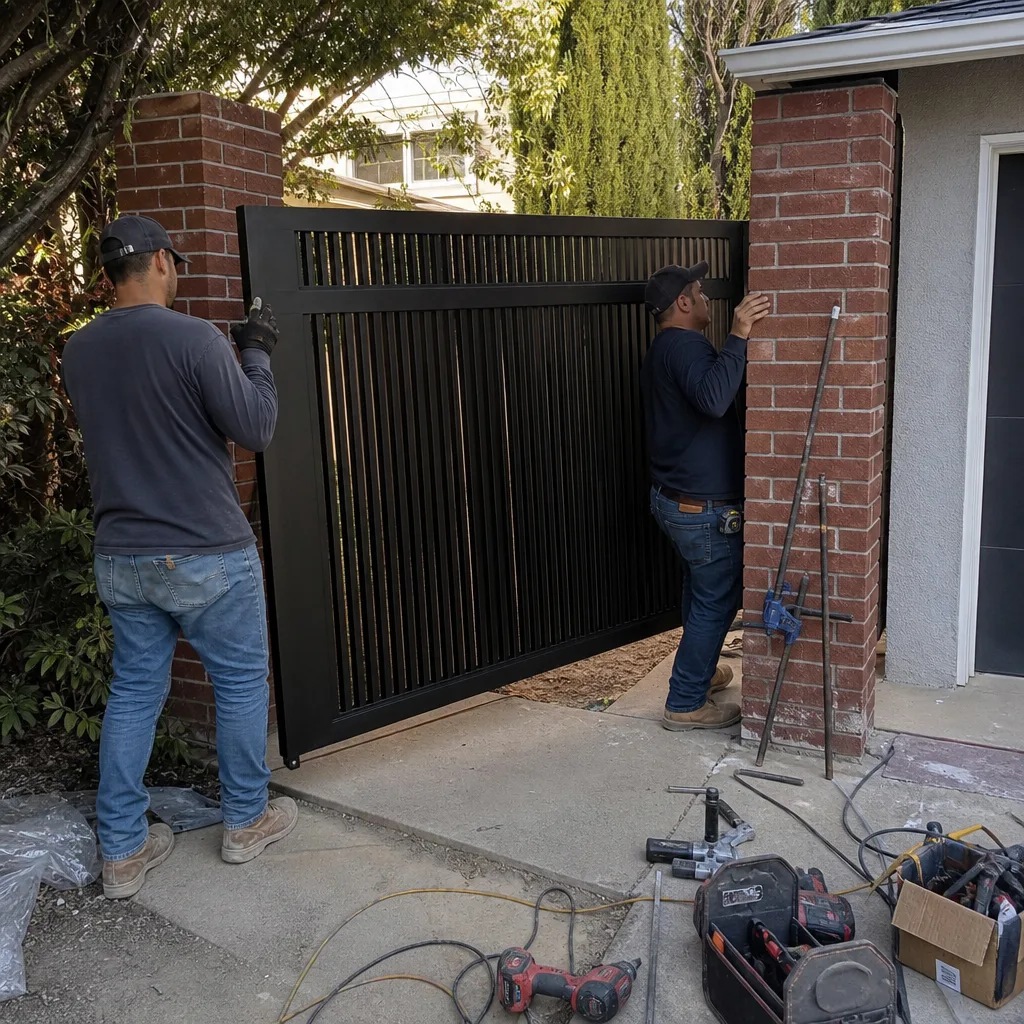
We’ll be direct about why this section exists. Every single day, we arrive at a Sherman Oaks gate where a previous repair was done by someone else, and no one knows what was installed, what was adjusted, or what the problem looked like before it was “fixed.” The homeowner paid for the work and has no record of it. So the next failure becomes a fresh diagnostic visit, and the homeowner pays to rediscover what was already known. Our fix for this is the documented photo record we leave on every job, but you can do a version of this yourself between service calls, and it will save you money on the next repair no matter who you use.
Here’s the minimum documentation routine, done in under five minutes with a phone camera:
- Photograph the operator head from straight on, close enough that the brand name and model number are legible. LiftMaster, DoorKing, and BFT all put the model on a data plate. That photo alone saves a technician a return trip for parts.
- Photograph the gate in the closed position from the hinge side, showing the gap between the leaf and the post. This is your baseline for post movement.
- Photograph the close gap measurement with a tape measure in the frame. This is your baseline for limit switch drift.
- Photograph the chain or belt tension point with your thumb pressing at the midpoint. You’re not trying to show deflection perfectly; you’re creating a before photo so the next one shows change.
- Photograph the battery terminals if accessible, showing whether there’s any corrosion or swelling.
Store these in a folder on your phone with the date in the filename. When a gate problem develops, pull up the baseline photos and compare. When a technician arrives, show them the photos. The diagnostic conversation goes from fifteen minutes of “when did it start” to “the close gap has grown by three-quarters of an inch since March, here are the photos.” When we hand you our written record at the end of a job, the same logic applies: a part number, a photo log of the before and after, and the limit-switch readings we set. That’s the standard we work to, and a homeowner’s own documentation between visits makes that standard stronger.
Seasonal Notes for Sherman Oaks: Brush Clearance, Heat, and Hills
Sherman Oaks has three seasons that actually affect a gate: the hot dry summer, the brush-clearance fall, and the rainy winter. Here’s how to time your maintenance checks.
Summer (June through October): Heat is the primary stressor. Motor enclosures in direct sun can hit 140°F internally, and thermal cutouts on residential operators start tripping around 150°F. If your gate stops working on a 100-degree afternoon and works again after sunset, that’s thermal protection, not an electrical fault. Check your photo-eye lenses for heat haze distortion (rare at these temperatures, but worth eliminating) and feel the operator enclosure. If you can’t keep your hand on it for five seconds, it’s too hot. Shade the enclosure or plan your gate usage around peak heat. Also, this is when battery voltage under load matters most, because heat accelerates battery aging.
Fall brush clearance (September through November): This is the particulate season we mentioned earlier. The Los Angeles County brush-clearance deadlines run from May through November depending on the zone, but the actual clearing happens in September and October for most Sherman Oaks hillside properties. That means fine ash and dust in the air for weeks. Clean your photo-eye lenses weekly during this stretch, not quarterly. Blow out the operator enclosure with compressed air if you have a can handy, focusing on the vents and the fan intake. And wipe down the track rails more often, because that dust is grinding into the wheel bearings every single cycle.
Winter rains (December through March): Water is the stressor. Check the operator enclosure’s weather seal. If the rubber gasket is cracked or missing, water is getting into the electronics. Check the battery tray for standing water. Check that the gate’s drainage path is clear; a slide gate sitting in a puddle at the low point of its travel will wick water into the track wheels and the rack. And check the posts again after heavy rain. Sherman Oaks hillside soil gets soft when saturated, and a post that was marginally stable through the dry season will move in the first big storm. Post movement after rain is the single most reliable predictor of the expensive repair we described earlier. For a deeper look at local requirements, see Gate Repair Permits, Codes & Inspections in CA: What You Need to Know.
Common Mistakes to Avoid
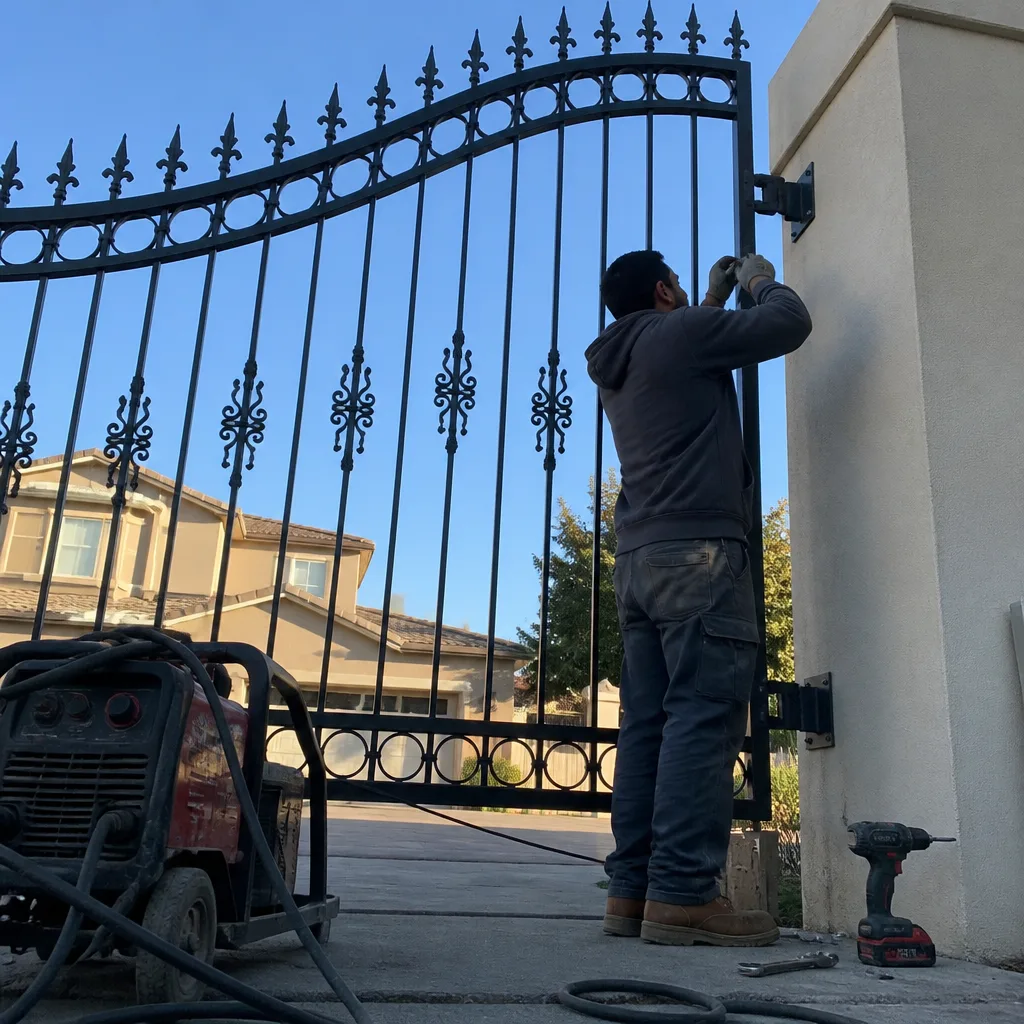
- Greasing a slide gate track. We see this constantly in Sherman Oaks. Grease on a track captures dust and turns into a grinding abrasive. Slide gate tracks run dry. If the wheels are noisy, they’re worn and need replacement.
- Ignoring a gate that “still works fine” while the close gap slowly grows. Limit switch drift doesn’t announce itself. By the time the gate stops working, the motor has been hammering the stop for months. The five-minute gap measurement we described catches it early.
- Tightening a chain until it “sings.” Over-tensioned chains load the motor shaft bearing and the sprocket teeth. The half-inch deflection rule is a maximum and a minimum. A chain pulled tight as a guitar string is doing damage in the other direction.
- Judging a battery by its resting voltage. The 12.6-volt reading at rest is misleading. The only number that matters is voltage under load, and the easiest way to check that from outside is timing the open cycle.
- Never taking a baseline photo. Without a photo of the close gap, the hinge alignment, and the chain tension from when things were working, every future problem is a guess. Five minutes of documentation today saves an hour of diagnostic time later.
- Assuming brush-clearance dust is harmless. It’s not. That particulate is fine enough to settle inside photo-eye housings and gear trains, and it accumulates fast in Sherman Oaks hillside neighborhoods. Clean optical lenses weekly during the fall clearing season.
When to Call a Professional
Call a gate technician when any single check produces a fail threshold, not when the gate stops working. If your chain deflection is over an inch, if your post has moved visibly in 30 days, if your limit switch readings are inconsistent by more than half an inch across three cycles, or if your battery voltage drops below 11 volts under load, those are all specific, actionable findings that justify a repair visit now rather than a breakdown later. Any work involving live 24V AC or 120V AC wiring, spring tension on a swing gate, or post re-setting is a professional job without exception. The electrical hazard is real, and the spring tension on some older Sherman Oaks gates can be lethal if released incorrectly. We do not offer DIY guidance on those items. Gate Installation in Sherman Oaks and full motor replacements are also professional work, and we provide a written price before any installation, repair, or parts order happens. Vance Gate Repair Sherman Oaks offers free estimates in Sherman Oaks - call (213) 463-6296.
Frequently Asked Questions
Do the full checklist every 90 days, but add a photo-eye lens wipe every week during the fall brush-clearance season from September through November. The particulate load in Sherman Oaks hillside neighborhoods during those months is high enough that quarterly cleaning is not enough. If your gate sees heavy daily use, do the full checklist every 60 days. Call (213) 463-6296 if any check produces a fail threshold and you want a written price before work begins.
Most of the checks in this guide cost nothing but time. A professional maintenance visit that includes chain tensioning, limit switch verification, photo-eye alignment, battery testing, and a written record typically runs $125 to $200 in Sherman Oaks depending on the gate type and the number of operators. Full motor replacement is a different category and usually runs $450 to $900 depending on brand and gate configuration. Our estimates are always written and handed to you before any work starts - call (213) 463-6296 for specific pricing.
The visual and measurement checks in this guide are homeowner-friendly: chain deflection, hinge play, photo-eye alignment, limit switch gap, and battery timing. Anything involving live electrical wiring, spring tension, post re-setting, or opening the operator head to adjust internal limits is a technician’s job. The hazard is real, and we never recommend DIY work on live 24V or 120V components. For the professional items, Vance Gate Repair Sherman Oaks gives you a written scope and price before work starts.
In our experience, it’s a three-way tie between photo-eye misalignment from brush-clearance dust, limit switch drift from years of unmeasured operation, and battery failure during power outages. The photo-eye issue is the easiest to prevent with weekly lens wipes in the fall, and the limit switch issue is the easiest to catch with the gap measurement described above. The battery issue is the one Sherman Oaks homeowners only discover when the power is out and the gate won’t open.
If your gate works fine in the morning and stops in the afternoon heat, that’s usually the operator’s thermal protection circuit cutting power to prevent motor damage. The internal temperature of an unshaded operator enclosure in Sherman Oaks can exceed 140°F in summer, and residential operators usually trip thermal protection between 140°F and 150°F. If this happens repeatedly, the enclosure needs shade or ventilation, and it’s worth a professional visit to confirm it’s thermal and not an early motor failure. Call (213) 463-6296 for a written diagnosis.
Photograph the operator data plate showing brand and model, the hinge-side gap with the gate closed, the close gap with a tape measure in frame, the chain or belt at the midpoint tension point, and the battery terminals if accessible. Date the folder and store it. When a problem develops, these photos become the diagnostic baseline that saves time and money on the next repair call. We follow the same habit on every visit: a documented photo record left with the homeowner and filed in the job record.
The Bottom Line
A useful gate maintenance checklist produces decisions, not reassurances. The half-inch chain deflection rule, the 2-degree hinge play rule, the three-cycle limit switch measurement, and the 11-volt battery load threshold are four numbers that will tell you more about your gate’s health than any amount of “it seems fine.” Do the checks every 90 days, adjust for Sherman Oaks seasons, and document everything with your phone camera. When a check fails, act on it. The repair that costs $125 today was a $900 replacement last year, and the difference was someone measuring instead of assuming. Vance Gate Repair Sherman Oaks is your source for the written record, the documented visit, and the flat price before any work starts.
Written by Adrian Vance, Owner at Vance Gate Repair Sherman Oaks, serving Sherman Oaks since 2014.